![[Logo] Your source for EUC, Ebike accessories and litium fire safety.](https://images.leadconnectorhq.com/image/f_webp/q_80/r_1200/u_https://assets.cdn.filesafe.space/25fElMd921Ylg1W3ctDz/media/6726aa8238b82f2b2f399cab.png)
8 Charging Mistakes That Increase Lithium Battery Fire Risk
Lithium-ion batteries power some of the most exciting personal electric vehicles on the market: electric unicycles, e-bikes, electric scooters, and more. But the same energy density that makes them so capable also makes charging habits critically important. Most lithium battery fires don't come out of nowhere. They're the result of avoidable mistakes made during charging. Jerry Bloodworth lost a three-car garage and two vehicles to a lithium scooter fire, despite doing many things right. His story is worth reading before you get to the list below.
Here are eight of the most common ones, and what to do instead.
Mistake 1: Charging Unattended (Especially Overnight)
The mistake: Plug in, go to sleep, assume the battery management system (BMS) will handle everything.
Why it's risky: If a failure occurs during the constant-current phase (early charging) or the voltage taper phase (near full charge), you won't notice the early warning signs: odor, excess heat, or light smoke. Lithium-ion failures escalate quickly, and time matters.
Safer practice:
Stay nearby during the first 20–30 minutes of charging
Avoid charging while asleep
Use a smart plug with an auto shutoff timer
Charge during hours you're awake and alert
"Not charging unattended, being present when devices are charging, is a big thing." — Shane Bentley, Co-Founder, FCL-X
Mistake 2: Using the Wrong Charger
The mistake: Using a charger from another device, an aftermarket high-amp "fast charger," a modified charger, or a cheap online replacement.
Why it's risky: Incorrect voltage or amperage can overstress cells, overheat wiring, and bypass BMS expectations. Overvoltage is one of the fastest ways to trigger internal instability.
Safer practice:
Use the manufacturer-approved charger
Match voltage exactly
Avoid boost charging unless your pack is specifically rated for it
Inspect your charger brick regularly for signs of overheating
Mistake 3: Charging Near Flammable Materials
The mistake: Charging next to cardboard boxes, gas cans, wood shelving, fabric, foam, or stored gear.
Why it's risky: Even a contained battery event can ignite surrounding materials, and that's usually what turns a manageable situation into a total loss. Most garage fires that start with a lithium battery spread because of what's nearby, not just the battery itself.
Safer practice:
Charge on a concrete or steel surface
Maintain 12–24 inches of clearance between devices
Keep a 3-foot clear zone around the charging area
Mistake 4: Ignoring Physical Damage
The mistake: Continuing to charge after a crash, a drop, water exposure, or a visible dent in the casing.
Why it's risky: Internal cell damage may not show immediately. Separator damage can create delayed internal short circuits. Thermal runaway can occur hours or even days later during a routine charge.
Safer practice:
Inspect thoroughly after any hard impact
If unsure, isolate the battery and observe it before charging again
Never charge a swollen or visibly dented pack
"Thermal runaway can occur hours or days later. Just because you stopped it doesn't mean there's not potential energy still stored." — Shane Bentley, Co-Founder, FCL-X
Mistake 5: Fast Charging High-Capacity Packs Frequently
The mistake: Constantly charging at maximum amperage for convenience.
Why it's risky: Fast charging increases internal resistance stress, raises internal temperatures, and accelerates cell degradation over time. Degraded cells are statistically more failure-prone and harder to predict.
Safer practice:
Use standard charge rate for routine, day-to-day charging
Reserve fast charging for when you actually need it
Allow the battery to cool before and after charging
Mistake 6: Charging in Extreme Temperatures
The mistake: Charging in a freezing garage in winter or a hot garage above 95°F (35°C) in summer.
Why it's risky: Cold charging can cause lithium plating, a condition where metallic lithium deposits on the anode and creates internal short-circuit risks. Hot charging increases internal instability and accelerates breakdown.
Safer practice:
Charge between approximately 50–85°F (10–30°C)
Allow the battery to reach room temperature before charging if it's been stored in the cold or heat
Mistake 7: Leaving Batteries at 100% for Extended Periods
The mistake: Charging to 100% and storing the device that way for days or weeks.
Why it's risky: High state-of-charge increases electrolyte stress and internal chemical reactivity. Over time, this degrades the pack faster, and a degraded pack carries a higher failure probability.
Safer practice:
Store long-term at 40–60% charge
Only charge to 100% when you're planning to ride soon
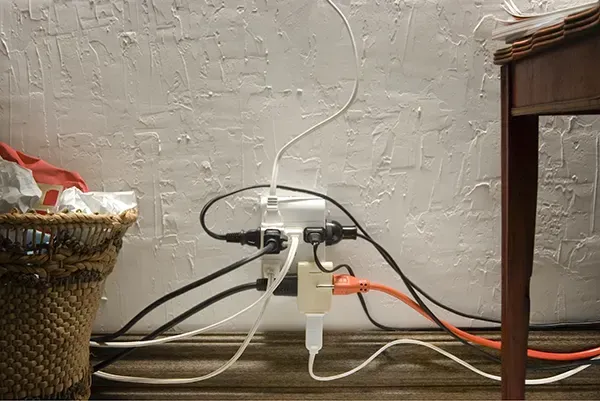
Mistake 8: Daisy-Chaining Chargers on a Single Outlet
The mistake: Running multiple chargers off one outlet through cheap extension cords or power strips.
Why it's risky: Overloaded circuits, heat buildup in cords, and loose plug connections are all hazards on their own. Combined with high-draw lithium chargers, they significantly increase the risk of an electrical fire. Electrical fires and battery fires together are extremely difficult to manage.
Safer practice:
Dedicate a circuit to your charging area if possible
Use a heavy-gauge extension cord rated for the load
Never stack multiple chargers on a single cheap power strip
One More Layer of Protection
"The education is far more valuable than the extinguisher that they're buying." — Shane Bentley, Co-Founder, FCL-X
Good charging habits eliminate the majority of lithium fire risk, but not all of it. Batteries fail. BMS units fail. Damage isn't always visible. For riders with high-capacity packs (and the four- and five-figure investments that come with them), having a lithium-specific fire extinguisher on hand is the last line of defense that actually works.
Standard ABC dry powder extinguishers and water won't stop a lithium thermal runaway, and in some cases can make it worse. We went deep on why with FCL-X co-founder Shane Bentley in Why Most Fire Extinguishers Won't Save Your EUC, Onewheel, or E-Bike. FCL-X is a UL-listed, water-based suppression agent engineered specifically for lithium-ion battery fires. We carry it at eRideLife because we believe every serious rider should have one within reach of their charging area.
Explore lithium fire safety products at eRideLife →
Lithium battery fires are uncommon but can escalate quickly, especially during charging. If you ride an electric unicycle, e-bike, e-moto, or scooter, it’s worth making sure your charging setup is as safe as possible. Download our free Lithium Battery Fire Safety Checklist for PEV Riders to quickly review charging location, battery inspection, warning signs, and the safety equipment you should have nearby: Lithium Battery Fire Safety Checklist for PEV Riders.
Safety Disclaimer: This article is for educational purposes only. In any fire emergency, call 911 immediately. Only attempt to suppress a fire if it is small, you have a clear and unobstructed exit behind you, you are not exposed to toxic gases, and you have the correct equipment. Never place yourself or others at risk to save property. If conditions are unsafe or the fire is growing beyond your control, evacuate immediately and leave firefighting to the professionals.