![[Logo] Your source for EUC, Ebike accessories and litium fire safety.](https://images.leadconnectorhq.com/image/f_webp/q_80/r_1200/u_https://assets.cdn.filesafe.space/25fElMd921Ylg1W3ctDz/media/6726aa8238b82f2b2f399cab.png)
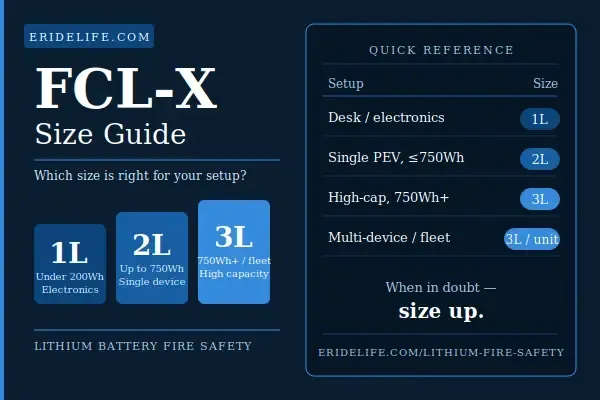
FCL-X 1L, 2L, or 3L: Which Size Do You Actually Need?
You've made the decision to get a lithium-rated fire extinguisher. Good. That choice matters. Now comes the follow-up question most people have to Google: which size?
FCL-X comes in three sizes for residential and light commercial use: 1L, 2L, and 3L. The difference isn't just price. It's discharge capacity, coverage area, and whether you have enough agent on hand when the seconds are running.
This isn't complicated to figure out. But getting it wrong is one of those mistakes you only discover when you need it most.
Why Size Matters Differently With Lithium Fires
With a standard ABC extinguisher, you're fighting combustion. Remove the fuel, remove the heat, remove the oxygen. The equation is manageable and the suppression math is relatively forgiving.
Lithium battery fires are a different problem. A pack in thermal runaway is generating its own heat internally. It's off-gassing flammable and toxic compounds. The chemical reaction is self-sustaining, not dependent on external oxygen. You can't starve it.
What you can do is suppress surrounding fire, slow heat transfer to adjacent cells, and buy time. That's what FCL-X is engineered to do. It penetrates the battery structure, works at the cell level to interrupt lithium oxidation, and creates a protective barrier against reignition. We covered the full science behind why standard extinguishers fall short in Why Most Fire Extinguishers Won't Save Your EUC, Onewheel, or E-Bike, including a deep conversation with FCL-X co-founder Shane Bentley.
The point is this: in a lithium fire, the agent doesn't just knock down flames. It's working chemistry. And more capacity means more agent, more contact time, and more protection for what's around the battery. That's why size matters here in a way it doesn't for most household fires.
Start With Your Battery Size
The primary variable in choosing an FCL-X size is watt-hours. Battery capacity is the single best predictor of how much heat a pack can generate during thermal runaway, how long a fire will sustain, and how much suppressant you need on hand to protect the surrounding area.
Here's how to find your number. Check the spec sheet on your device, the manufacturer's website, or the battery label itself. Most manufacturers list watt-hours (Wh) directly. If yours lists voltage and amp-hours instead, multiply them together: 67.2V × 10Ah = 672Wh.
If you're not sure, round up. Sizing up is always the right call when the downside of underpreparing is a structure fire. To understand what's actually happening inside a battery when things go wrong, see our breakdown of what thermal runaway is and why PEV fires behave differently.
The 1L: Small Electronics and Desktop Charging
The 1L FCL-X is the right size for small electronics. Laptops, cameras, drones, power tool batteries, small personal devices. It's not the right tool for a PEV charging setup.
If you're reading this because you own an EUC, e-bike, Onewheel, or electric scooter, skip the 1L unless you're buying it as a secondary unit for a different area. A single charge cycle on even a modest PEV battery represents orders of magnitude more stored energy than a laptop, and you need extinguisher capacity that reflects that.
The 1L belongs near your desk or electronics charging station. For the garage or charging room where your PEV lives, keep reading.
The 2L: Single Device, Under 750Wh
This is the right call for most single-device residential charging setups, as long as your battery falls under 750Wh.
That covers a lot of ground. An entry-level EUC in the 400 to 600Wh range. A compact e-bike with a standard city battery. A Onewheel GT. A single mid-range scooter. If you're charging one device at a time and the battery is under 750Wh, the 2L gives you the capacity to address the fire surrounding the pack and protect your space while you and your family evacuate.
The 2L is lighter and easier for most people to operate with one hand. For someone in a tight garage or a smaller storage space, that handling difference matters. You don't want to be fumbling with a heavy cylinder when your exit window is closing.
A few things to get right alongside the extinguisher:
Keep it within three to six feet of your charging device. Not on the other side of the garage. Not in a cabinet. On the wall, accessible, visible, at shoulder height. If you have to search for it when a fire starts, you've already lost time you can't get back.
A fire-resistant mat or metal tray under the device is worth having too. The extinguisher handles what spreads outward. The mat helps contain what drips down. For a full rundown of how to organize your space correctly, see our guide to setting up a safe lithium battery charging station in your garage.
The 3L: Large Packs, High-Capacity Devices, or Any Setup Above 750Wh
If your battery exceeds 750Wh, the 3L is the correct choice. Period.
The high-performance EUC market has moved into serious energy density territory. The Begode ET MAX runs 3,000Wh. A Sherman S or a Veteran Sherman can push past 2,000Wh. E-motos and high-range e-bikes regularly land in the 1,000 to 2,000Wh range. Charging one of those packs is a meaningfully different risk profile than charging a starter wheel.
Larger batteries release more heat, produce more gas during thermal runaway, and sustain fire longer. The 3L gives you more agent, more discharge time, and more margin to protect the structure around the device while emergency services are on the way.
The 3L also applies when you're operating near the ceiling of the 2L range. If your single device is 650 or 700Wh and you want margin, size up. The extra capacity costs you a few extra pounds on the wall mount and a few extra dollars. That's a reasonable trade.
Jerry Bloodworth charged in a detached garage, used the original charger, hadn't modified anything. He still lost a three-car garage, two vehicles, and nearly $200,000. Read his full story here to understand what the first minutes of a lithium fire actually look like, and why having the right tool on the wall matters more than any other variable.
Multi-Device and Workshop Setups: Multiple Units Required
This is where the math changes entirely.
If you're charging two or more devices simultaneously, or running a small workshop, shop, or repair operation with multiple packs in rotation, the risk profile scales with every device you add. Thermal runaway in one battery can spread heat to adjacent packs. A cascade failure turns a single-device incident into a multi-pack fire with significantly more heat, gas production, and total burn duration.
The guidance here is direct: plan for at least one 3L per two to three devices in your charging setup. Space units a minimum of 12 to 24 inches apart. If you have a dedicated charging row, each row should have its own extinguisher. Don't plan to cover a five-device charging station with one unit mounted at the far end.
A fire blanket is a useful backup in a multi-device environment, but it supplements the extinguisher. It doesn't replace it. For a broader look at commercial and fleet-scale options, see our commercial lithium fire safety line.
Annual Maintenance and the Recharge Plan
Both the 2L and 3L require annual inspection. Check the pressure gauge regularly. If the gauge drops out of the green zone, the unit needs service before you need it in an emergency.
FCL-X units can be recharged after use. Don't treat a discharged extinguisher as a single-use item. Get it serviced and back on the wall. The gap between discharge and recharge is a window of exposure you don't want to leave open.
FCL-X is certified to the Dutch NTA 8133 standard, the leading international benchmark for lithium-ion fire suppression products. That certification matters when you're choosing between products that look similar on the shelf.
Quick Reference
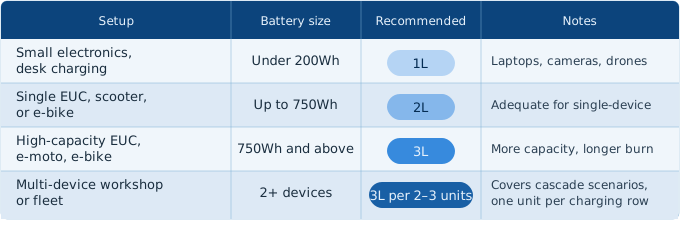
When in doubt, size up. The cost difference between a 2L and a 3L is not the number you want to be calculating after a garage fire.
What the Extinguisher Can and Can't Do
Be clear on this. An FCL-X extinguisher is not going to stop thermal runaway inside the battery cell once a full cascade is underway. What it does is suppress the fire around the battery, reduce toxic gas production, interrupt the oxidation process, and protect the structure and contents of your space while you and your family get out and emergency services arrive.
That's not a limitation. That's what fire suppression is designed to do. You are the first responder in the first minute. The extinguisher is your tool. Use it correctly and the outcome is dramatically different than walking past it to the door. 10 reasons every PEV owner needs a lithium fire extinguisher lays out the full case, including why reignition is the hidden variable most riders never think about.
Always call 911 when a lithium fire starts. Only attempt suppression if the fire is small, you have a clear exit behind you, and you have the right equipment. If conditions change, leave. No property is worth it.
The One Decision That Doesn't Need to Wait
You already ride with more battery than most people keep in their entire house. Your garage is not set up for average household risk. It's set up for a PEV rider's risk.
The right size FCL-X on your wall is proportionate to the exposure you already have. Figure out your watt-hours, use this guide, and get it on the wall before you need it.
Lithium battery fires are uncommon but can escalate quickly, especially during charging. If you ride an electric unicycle, e-bike, e-moto, or scooter, it's worth making sure your charging setup is as safe as possible. Download our free Lithium Battery Fire Safety Checklist for PEV Riders to quickly review charging location, battery inspection, warning signs, and the safety equipment you should have nearby.
Explore FCL-X lithium fire extinguishers at eRideLife.
Safety Disclaimer: This article is for educational purposes only. In any fire emergency, call 911 immediately. Only attempt to suppress a fire if it is small, you have a clear and unobstructed exit behind you, you are not exposed to toxic gases, and you have the correct equipment. Never place yourself or others at risk to save property. If conditions are unsafe or the fire is growing beyond your control, evacuate immediately and leave firefighting to the professionals.
Note: FCL-X is a UL listed Class A wetting agent. It is not rated as a Class C (electrical) extinguisher and should not be used as a substitute for code-required ABC extinguishers in commercial or residential settings where such extinguishers are mandated by ordinance or code. Always follow proper safety protocols and consult a professional for your specific situation.