![[Logo] Your source for EUC, Ebike accessories and litium fire safety.](https://images.leadconnectorhq.com/image/f_webp/q_80/r_1200/u_https://assets.cdn.filesafe.space/25fElMd921Ylg1W3ctDz/media/6726aa8238b82f2b2f399cab.png)
What Is Thermal Runaway? Lithium Battery Fire Science for PEV Riders
If you ride an electric unicycle, e-bike, Onewheel, or any lithium-powered PEV, you've probably heard the term "thermal runaway." Maybe in a news headline. Maybe in a forum post after someone's garage burned down.
But most riders don't actually know what it means — or why it makes lithium battery fires so different from every other kind of fire.
This article breaks it down. No fluff, no fear-mongering. Just the science behind what's happening inside the battery when things go wrong, why it matters, and what you can do about it.
If you've already read Jerry Bloodworth's story about losing over $200,000 to a lithium scooter fire, this is the "why" behind what happened that night.
TL;DR: Thermal runaway is a chain reaction inside a lithium battery cell where heat triggers more heat until the cell ignites or explodes. Unlike normal fires, the battery generates its own oxygen, so smothering won't stop it. It escalates in seconds, can reignite hours later, and spreads cell to cell through the pack. Prevention is your best defense. If you do nothing else, download the free safety checklist.
Thermal Runaway Defined: It's Not Just "A Battery Catching Fire"
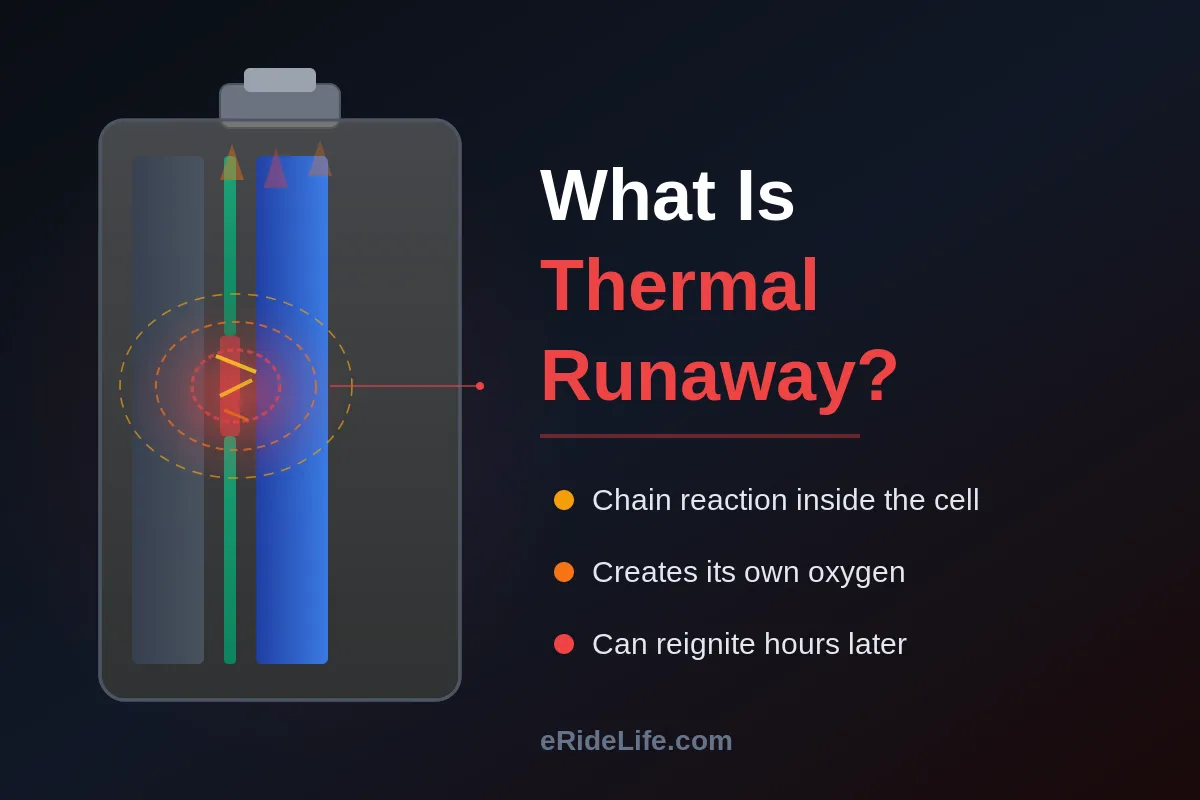
Thermal runaway is a self-accelerating chain reaction inside a lithium-ion battery cell. Rising temperature triggers chemical reactions that generate even more heat — until the cell vents, ignites, or explodes.
It's not a slow burn. It's a chemical cascade failure.
And once it starts, it is extremely difficult to stop.
"Thermal runaway can occur hours or days later. Just because you stopped it doesn't mean there's not a chemical reaction still happening inside the battery." — Shane Bentley, Co-Founder, Full Circle Lithium
What's Inside a Lithium-Ion Battery Cell
To understand thermal runaway, you need to understand what's inside the battery. Every lithium-ion cell contains:
Anode — typically graphite
Cathode — lithium metal oxide (NMC, LFP, etc.)
Electrolyte — a flammable organic solvent
Separator — a thin plastic membrane keeping the anode and cathode apart
Metal casing
The key detail: the electrolyte is highly flammable, and the separator is made of plastic that melts under heat.
That's where runaway begins.
How Thermal Runaway Happens in a Lithium Battery — Step by Step
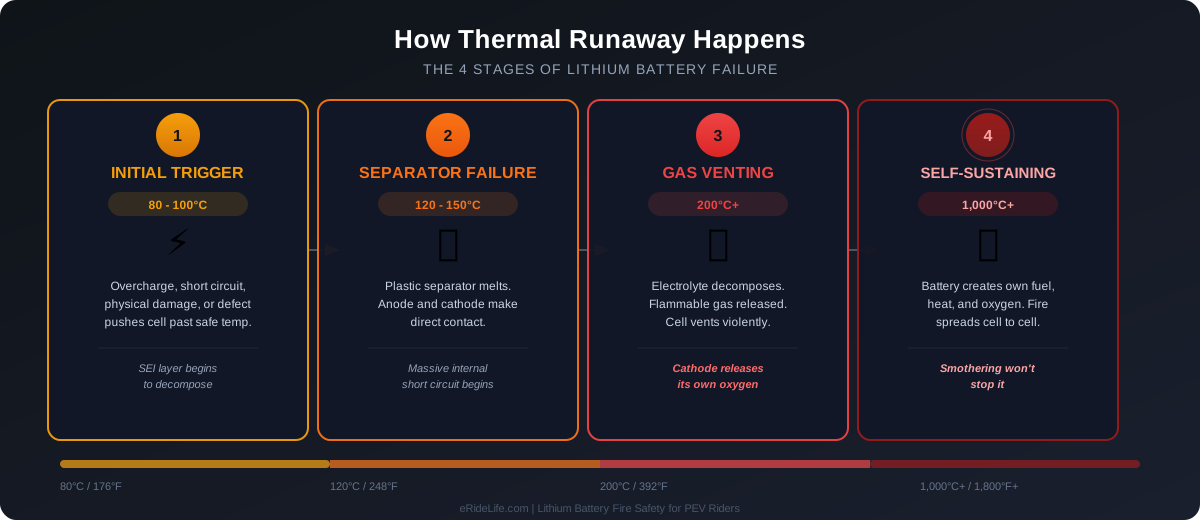
Stage 1: Initial Trigger
Something pushes the cell past its safe operating temperature. This can be:
Overcharging
An internal short circuit
Physical damage (crash, drop, puncture)
A manufacturing defect
External heat exposure
Temperature rises past roughly 80–100°C (176–212°F). At this point, the solid electrolyte interphase (SEI) layer — a thin protective coating on the anode — begins to decompose.
The cell is now generating heat it wasn't designed to handle.
If you're not sure whether your charging habits are putting you at risk, check out our breakdown of 8 charging mistakes that increase lithium battery fire risk.
Stage 2: Separator Failure
At approximately 120–150°C, the plastic separator melts. The anode and cathode — which were never supposed to touch — make direct contact.
This creates a massive internal short circuit. The cell is now generating intense heat from the inside, and there is no way to reverse it.
Stage 3: Electrolyte Ignition and Gas Venting
At 200°C and above, the electrolyte decomposes. Flammable gases are released. And here's the part that changes everything:
The cathode breaks down and releases oxygen.
The battery is now generating its own fuel, its own heat, and its own oxygen — all inside a sealed metal casing. Pressure builds. The cell vents violently.
This is the critical difference between a lithium battery fire and every other fire you've encountered.
Stage 4: Self-Sustaining Reaction
Because the oxygen is being produced chemically from inside the cell:
Smothering doesn't always work
Flames can reignite after they appear extinguished
The fire continues even without external air
And if the cell is part of a multi-cell pack — which every PEV battery is — that heat conducts directly into neighboring cells.
That's cell-to-cell propagation. One cell fails, heats the next, and the cascade continues through the entire pack.
Why Lithium Battery Fires Don't Behave Like Normal Fires
Lithium Batteries Create Their Own Oxygen
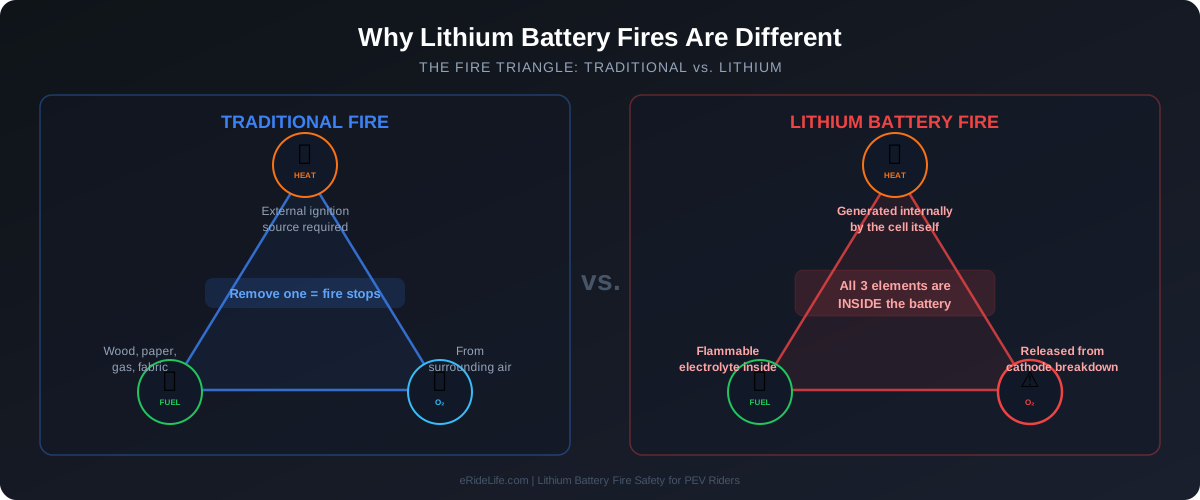
A traditional fire needs three things: fuel, heat, and oxygen from the air. Remove one and the fire goes out. That's the basis of every fire suppression strategy you've ever learned.
Lithium battery fires break that model. The cell contains fuel (electrolyte), generates heat (exothermic reaction), and releases oxygen (cathode decomposition). Block outside air and the reaction can still continue.
This is why we covered in detail why most fire extinguishers won't stop a lithium battery fire — and what actually works.
"You've got to have something in your product to neutralize the chemical reaction. There's nothing on the market that does that — other than FCL-X." — Shane Bentley
Thermal Runaway Escalates in Seconds
Thermal runaway can go from initial trigger to full ignition in under a minute. There's no slow ramp. No warning light that gives you five minutes to react. The transition from "something smells off" to "the garage is on fire" can happen faster than most people can process what's going on.
Large PEV battery packs store anywhere from 500 to over 2,000 watt-hours of energy. To put that in perspective, that's a significant amount of stored chemical energy packed into a relatively small space. When that energy releases uncontrollably, heat output can exceed 1,000°C (1,800°F).
Lithium Battery Fires Reignite
Even if the flames appear extinguished, the internal chemical reaction may still be active. Cells can reignite minutes or hours later. This is exactly what happened to Jerry Bloodworth — four hours after the fire department left, the battery reignited and caused a second three-alarm response.
Fire departments dealing with lithium battery fires often submerge the pack, use massive volumes of water for cooling, and monitor for extended periods.
Jet Flames, Explosions, and Projectiles
When cells rupture under pressure, superheated gases vent outward. Flames can shoot in unpredictable directions. Cell casings and internal components can become projectiles. This isn't a candle tipping over. It behaves more like a blowtorch with no off switch.
This makes confined charging areas especially dangerous. A battery venting in a tight garage corner surrounded by cardboard, gas cans, and wood shelving is a completely different scenario than a battery venting on an open concrete pad with nothing nearby.
This is exactly why setting up a proper charging station with clearance, non-combustible surfaces, and a clear exit path matters so much.
How Lithium Fires Spread Through PEV Battery Packs (Cell-to-Cell Propagation)
Your e-bike, EUC, or Onewheel doesn't run on a single cell. It uses a multi-cell pack containing dozens to hundreds of individual cells.
When one cell enters thermal runaway, the fire spreads through the pack via:
Heat conduction — one cell heats adjacent cells past their threshold
Mechanical failure — a rupturing cell physically damages its neighbors
Thermal propagation — the cascade continues layer by layer through the pack
Poor pack design accelerates this. A cheaply assembled battery with no thermal barriers and thin cell spacing can go from one failed cell to a fully involved pack fire in seconds.
Better-engineered packs include thermal barriers between cells, flame retardant separators, pressure vent channels, and battery management systems (BMS) designed to detect and respond to abnormal conditions. This is one reason why aftermarket and no-name replacement batteries carry higher risk — they often skip the engineering that slows or prevents propagation.
"Water will cool it. Water will take the fire away. But as soon as you stop spraying water on it, guess what happens? It reignites." — Shane Bentley
Preventing Thermal Runaway: Why Prevention Beats Suppression
Once thermal runaway begins, suppression is about protecting everything around the battery. Cooling is more important than smothering. And even with the right suppression tools, you're fighting a reaction that wants to sustain itself.
"The education is far more valuable than the extinguisher that they're buying." — Shane Bentley
The best safety strategy is prevention:
Prevent overcharge — use the manufacturer's charger, match voltage exactly
Prevent physical damage — inspect after crashes, never charge a swollen pack
Prevent overheating — charge between 50–85°F, allow cooling before and after
Avoid charging unattended — especially overnight
Store in a temperature-controlled environment — away from flammable materials
We go deeper on each of these in our guide to 8 charging mistakes that increase fire risk and our walkthrough on how to set up a safe charging station in your garage.
Why Thermal Runaway Matters for E-Bike, EUC, and PEV Owners
E-bikes, electric unicycles, Onewheels, and scooters use high-density lithium-ion packs. Risk increases with high-capacity fast chargers, modified firmware, aftermarket batteries, and impact damage from crashes.
If you operate events, run a fleet, or charge multiple devices in the same space — thermal runaway risk scales with volume. That's why having the right suppression on hand matters, and we break down 10 reasons every PEV owner needs a lithium fire extinguisher.
If you're buying used PEVs, pay attention to the battery's history. A wheel that's been crashed, submerged, or modified may look fine on the outside — but the separator damage that leads to thermal runaway is invisible.
Understanding thermal runaway doesn't just make you a smarter rider. It makes you a safer one. And if something does go wrong, having the right tool within reach is the difference between a contained incident and a total loss.
eRideLife carries lithium battery fire extinguishers specifically designed for PEV charging environments.
Lithium battery fires are uncommon but can escalate quickly, especially during charging. If you ride an electric unicycle, e-bike, e-moto, or scooter, download our free Lithium Battery Fire Safety Checklist for PEV Riders — it covers everything from charging setup to emergency response.
Download the Lithium Battery Fire Safety Checklist →
Safety Disclaimer: This article is for educational purposes only. In any fire emergency, call 911 immediately. Do not attempt to fight a lithium battery fire unless it is safe to do so. Always have an exit plan.
Suggested Tags: thermal runaway, what is thermal runaway, lithium battery fire science, lithium battery thermal runaway, PEV battery fire, EUC battery safety, e-bike thermal runaway, lithium fire prevention, how lithium batteries catch fire, lithium cell propagation